71% of Brands in ChatGPT Fanout Queries Make It Into the Answer (40K Prompts Studied)

By Antony Deroshan
Co-founder at Mention Science
9 min read
When ChatGPT uses web search, it writes its own fanout queries—and those queries often name brands before a single page is read.
So does being named in a fanout query actually get you into the answer?
We analyzed 39,834 ChatGPT prompts and their 76,338 fanout queries to find out.
71.4% of brands in ChatGPT fanout queries make it into the final answer. But 51.1% of the brands in the answer were never in a fanout query at all.
Here’s what we found…
Key takeaways
- 71.4% of brands named in a ChatGPT fanout query make it into the final answer (58.2% on an exact name match).
- Brands in the first fanout query reach the answer about 77% of the time, versus roughly 42–52% for brands that only appear in later queries.
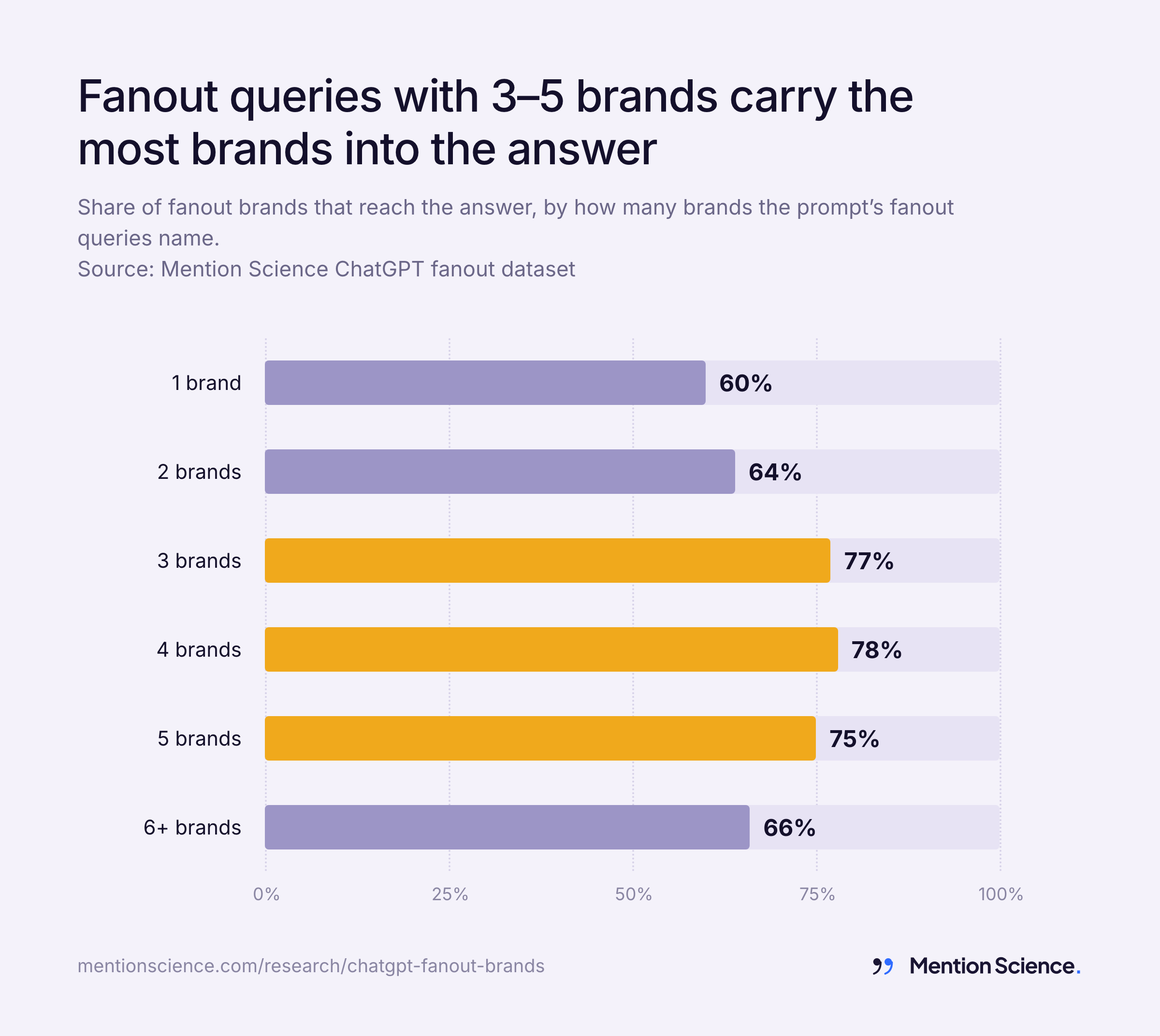
- When the fanout queries name a single brand, it reaches the answer only 59.3% of the time. With 3–5 brands, around 75–78% get through.
- 51.1% of the brands in ChatGPT’s answers were never in a fanout query.
- 70.1% of answers include at least one brand that no fanout query named.
- In two smaller checks, 51% and 57% of those extra brands were written on a page the answer cited.
71% of brands in ChatGPT fanout queries make it into the answer
Out of 108,396 brands named in ChatGPT fanout queries, 77,381 also appear in the final answer.
That’s 71.4%.
On an exact name match alone, the figure drops to 58.2%. The gap is brands that show up in the answer under a longer name—usually a product line, like Samsung → Samsung Galaxy.
There are a few ways to slice this, and they often get mixed up, so here they are side by side:
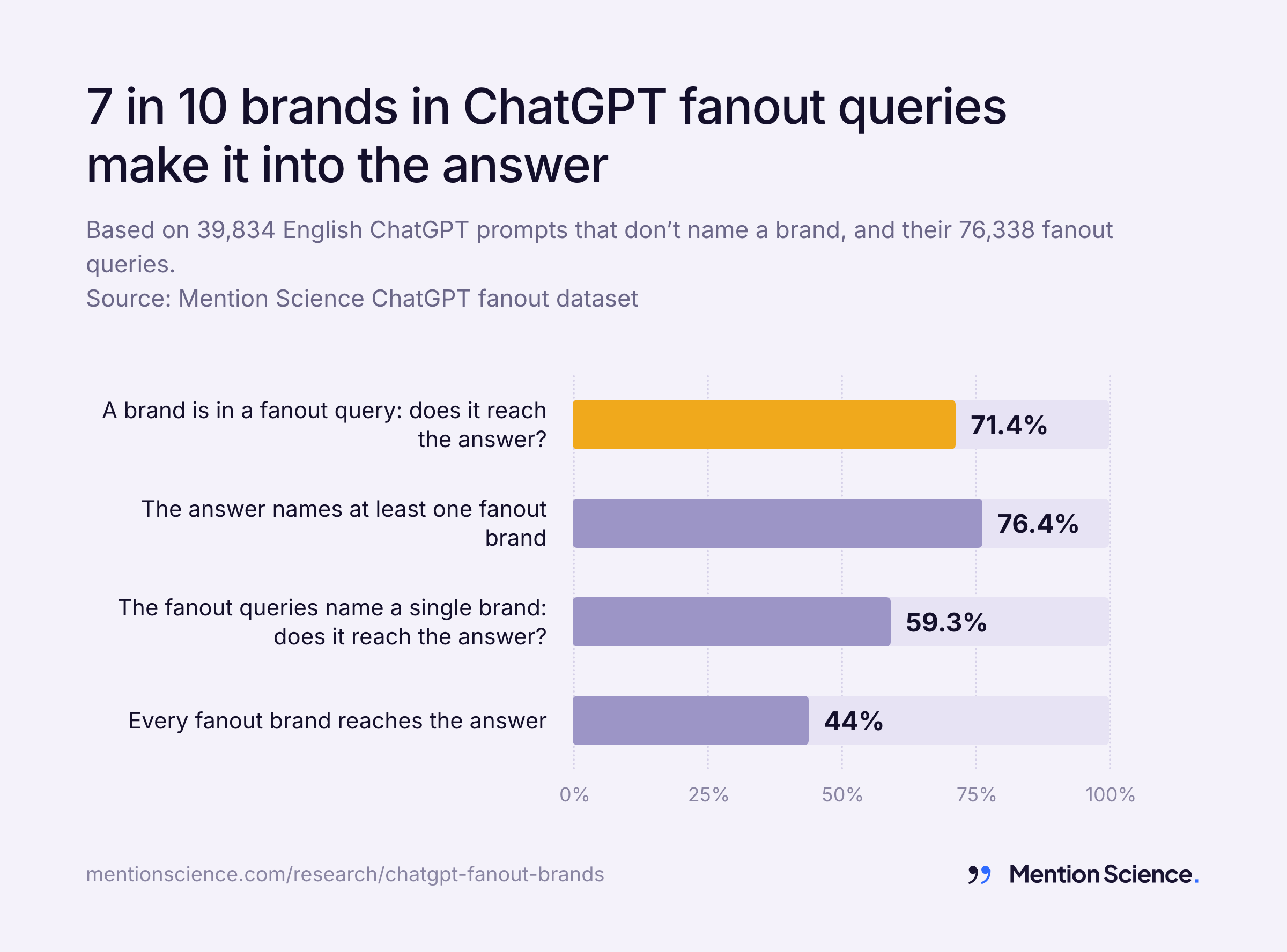
The 76.4% figure is per answer, not per brand. An answer that names one out of three fanout brands still counts.
If you own a brand, the number that matters is 71.4%.
Example: every fanout brand makes the answer
For “What’s the best CRM software for a small business?”, ChatGPT’s fanout queries named five brands.
The answer shortlisted exactly those five—no more, no less:
| Brand | In a fanout query? | In the answer? |
|---|---|---|
| HubSpot | Yes | Yes |
| Zoho | Yes | Yes |
| Pipedrive | Yes | Yes |
| Salesforce | Yes | Yes |
| Freshsales | Yes | Yes |
Example: some fanout brands make it, some don’t
For “What is the best personal loan in Australia?”, six brands appeared across the fanout queries.
Three of them made the answer:
| Fanout query | Brands | In the answer? |
|---|---|---|
best personal loans Australia 2026 comparison rates | — | — |
Australia personal loan comparison rates 2026 Canstar Finder Mozo | Canstar, Finder, Mozo | No |
site:ourmoneymarket.com.au personal loan 5.95 comparison rate | — (not extracted) | — |
site:revolut.com/en-AU personal loan Australia 6.99 | Revolut | Yes |
site:ing.com.au personal loan 6.19 Australia | ING | Yes |
site:nowfinance.com.au no fee unsecured personal loan 5.95 | NOW Finance | Yes |
Finder never appears in the answer. Canstar and Mozo show up only as source links, not as lenders.
The answer also recommends OurMoneyMarket. Its domain was in a site: query, but the brand wasn’t extracted from it, so it counts as an extra brand here.
Brands in the first fanout query reach the answer 77% of the time
Most fanout brands (about 84%) first appear in query 1.
That first query reads like a category shortlist—something like best CRM for small business HubSpot Zoho Pipedrive.
And its brands make the answer about 77% of the time:
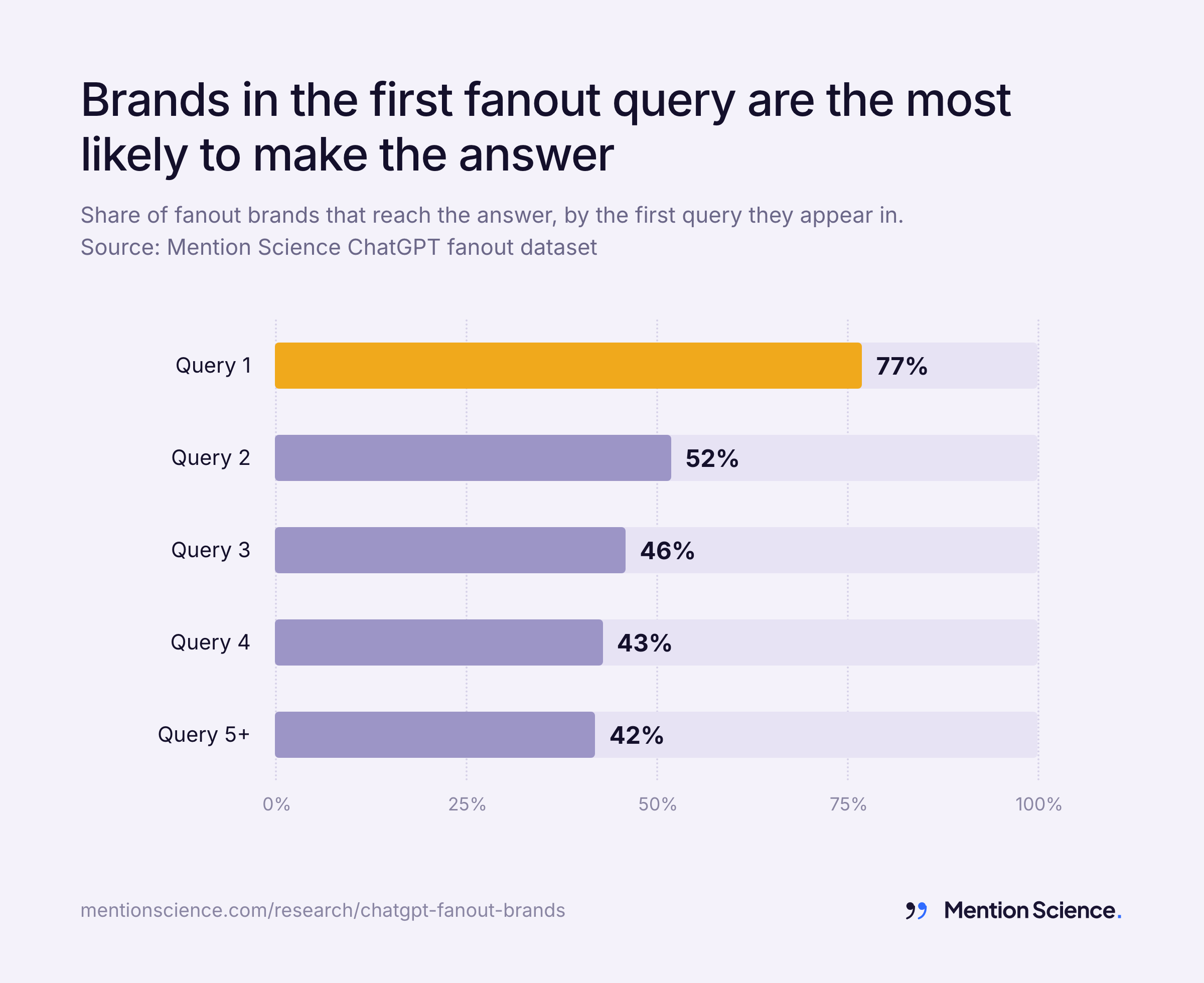
Brands that only show up in later queries do much worse, at about 42–52%.
To me, that suggests later queries are checks rather than shortlists. They tend to look up a specific brand, a review site, or run a site: search.
Single-brand fanout queries reach the answer only 59% of the time
The number of brands in the fanout queries matters too.
When ChatGPT names only one brand, that brand makes the answer just 59.3% of the time (4,684 of 7,899).
Fanout queries with 3–5 brands look like a real shortlist, and around three in four of those brands get through:
51% of the brands in ChatGPT’s answers were never in a fanout query
Now flip the question around.
Of the 167,742 brands in ChatGPT’s answers, 51.1% were not named in any fanout query for that prompt:
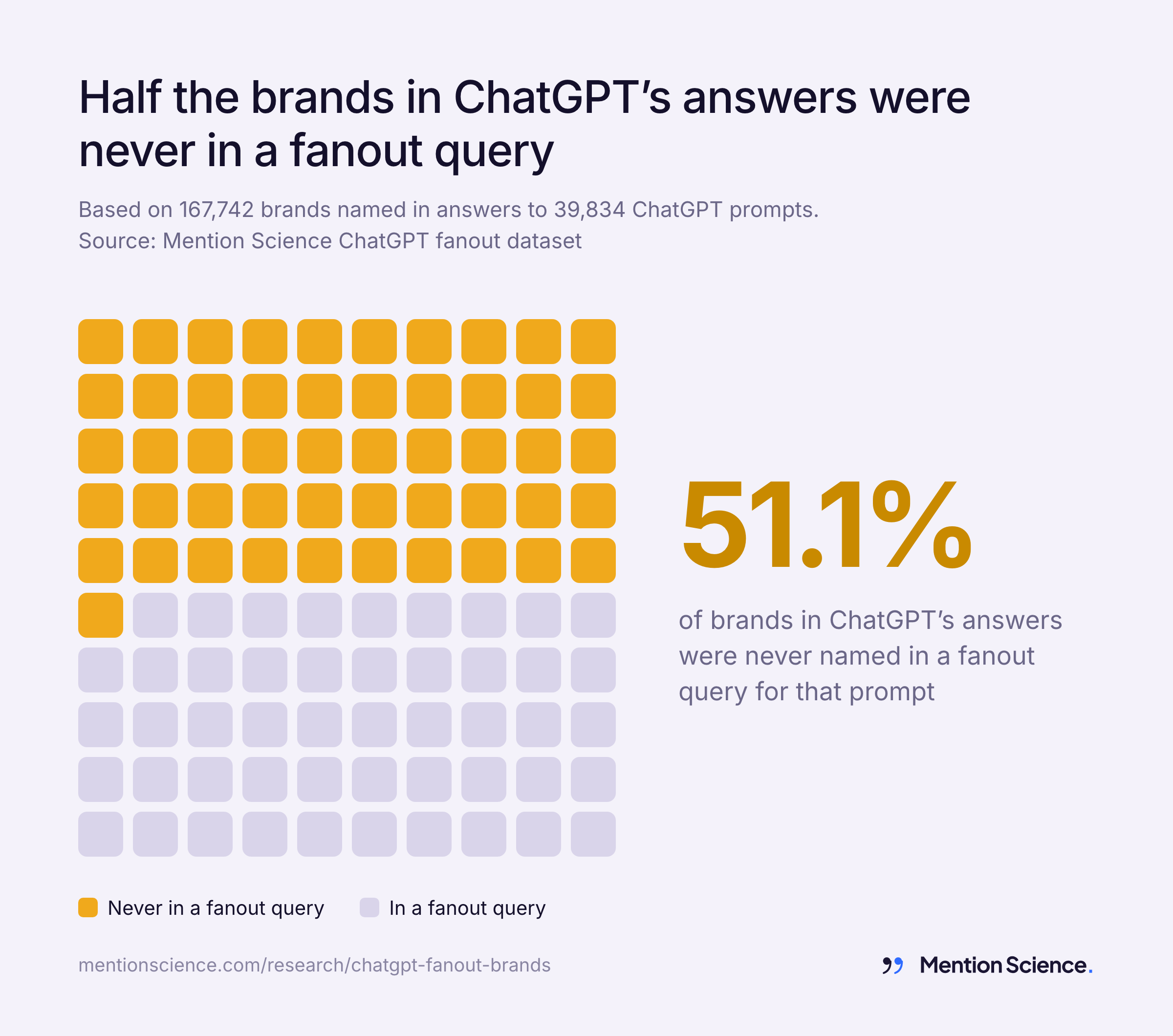
That’s not a rare edge case, either. 70.1% of answers contain at least one of these extra brands.
The brands added most often are big, general names that the answer mentions alongside the brands it went looking for:
| # | Brand | Prompts |
|---|---|---|
| 1 | Apple | 455 |
| 2 | Samsung | 370 |
| 3 | 208 | |
| 4 | Toyota | 179 |
| 5 | Honda | 155 |
| 6 | Nike | 150 |
| 7 | Adidas | 141 |
| 8 | Xiaomi | 132 |
| 9 | Amazon | 130 |
| 10 | ChatGPT | 124 |
Most extra brands are written on the pages ChatGPT cites
So where do the extra brands come from?
Our dataset stores the prompt, the fanout queries and the answer—but not every page ChatGPT retrieved. So we ran two smaller checks.
| Check | Extra brands on a cited page | Share |
|---|---|---|
| Scraped sample (20 prompts) | 25 of 49 | 51% |
| Live API run (8 unbranded prompts) | 8 of 14 | 57% |
In both, about half of the extra brands were written on a page the answer cited.
Case study: instant coffee in Australia
We replayed “What is the best instant coffee to buy in Australia?” with web search on.
The prompt names no brand. ChatGPT wrote three fanout queries:
best instant coffee Australia 2026 reviewsbest instant coffee Australia Choice taste testAustralia instant coffee Moccona Nescafe Gold specialty instant coffee reviews
Only query 3 names brands: Moccona and Nescafé Gold. Query 2 points at Choice, a consumer review site.
The answer cited one URL, six times: Choice’s instant coffee review. Then it recommended seven brands:
| Recommended brand | In a fanout query? |
|---|---|
| Moccona | Yes |
| Nescafé Gold | Yes |
| Bushells Classic Gourmet (top pick) | No |
| Vittoria Mountain Grown | No |
| Coles Classic Smooth & Bold | No |
| Alcafé Gold Classic Dark Roast | No |
| Lavazza Prontissimo | No |
All seven are on the Choice page the answer cited. And the top pick was Bushells—because Choice scored it 83%:
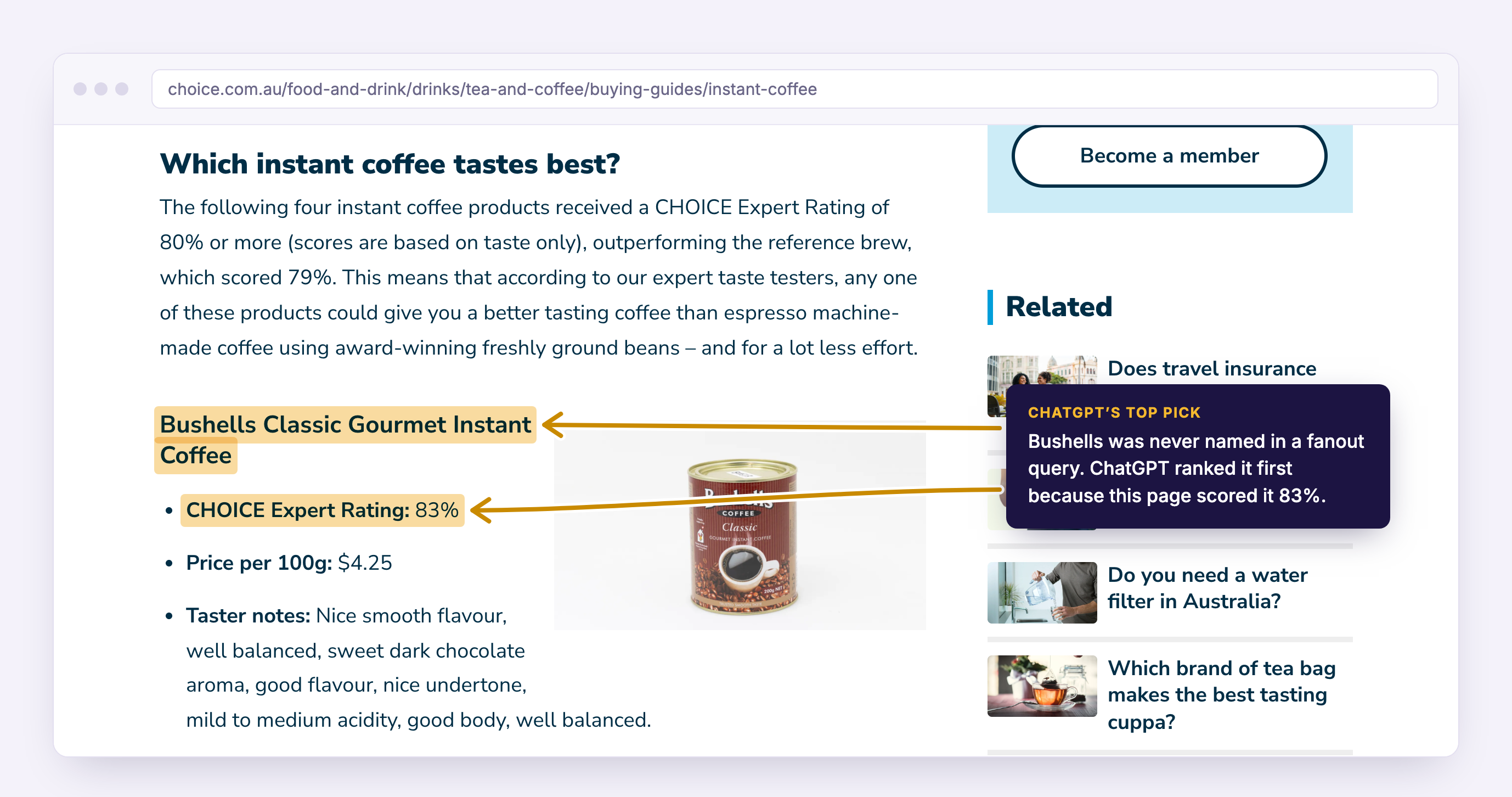
Moccona was named in the fanout query and still lost to a brand that no query mentioned.
Another interesting finding: the model’s reasoning note, written before the answer, already had Choice’s ranking.
The same pattern shows up elsewhere. A Choice roundup brings in Robert Timms and Aldi next to Moccona. A TechGearLab roundup brings in Therabody and Hypervolt next to Theragun. An Independent roundup brings in T3 and Helios next to Dyson.
How to get your brand into ChatGPT’s answers
So, what does all of this data actually mean?
In short, there are two ways into a ChatGPT answer: be named in the fanout query, or be named on the pages that query pulls back.
1. Track fanout queries, not just answers
Most AI visibility tracking looks at the final answer.
But the fanout query sits upstream of it—and a brand named there has a 71% chance of being in the answer. Monitor which of your buyers’ prompts produce a fanout query with your brand in it.
2. Aim for the first query
Brands in the first fanout query reach the answer about 77% of the time.
Later queries look like follow-up checks, and their brands carry through far less often. The goal is to be part of the category shortlist, not a one-off mention.
3. Get listed on the pages that rank for your category
Half the brands in an answer were never in a fanout query.
They come in from roundups, reviews and comparison pages the queries retrieve. If Choice ranks you first, you can beat a brand that ChatGPT went looking for by name.
4. Watch the review sites the fanout queries name
Fanout queries often name publishers like Choice, Canstar or Finder, and run site: searches against brand domains.
Those pages are where the shortlist comes from. Earn your place on them with reviews, data and digital PR.
How our data compares to other studies
Suganthan Mohanadasan’s study measured the same thing on a much smaller sample: did a brand named in a fanout query appear in the final answer?
| Study | Sample | Fanout brands that reach the answer |
|---|---|---|
| Mention Science | 108,396 brands | 71.4% |
| Suganthan Mohanadasan | 119 brands | 68.9% |
The two numbers line up closely.
The same study also found that brands named only on fetched pages reached the answer about 2% of the time. At first glance, that looks like it contradicts our 51.1%.
It doesn’t. The two figures divide by different things:
- 2% is a per-brand chance: of every brand on a fetched page that no query named, how many made the answer?
- 51.1% is the make-up of the answer: of every brand in the answer, how many were never queried?
A single roundup page can name a dozen brands, so the pool of unqueried brands is huge. A low hit rate on a huge pool still fills half the answer.
In other words, both numbers hold at once.
Methodology
We used our own dataset of ChatGPT web search sessions, captured from the same interface people use. For each session, we stored the prompt, every fanout query and the final answer.
From that, we built the sample for this study:
- English prompts that don’t name a brand, so any brand in a fanout query was added by ChatGPT, not copied from the user.
- Prompts where at least one fanout query does name a brand.
- One answer per prompt. Where a prompt was answered more than once (17,632 prompts), we kept the first stored answer.
That gave us 39,834 prompts, 76,338 fanout queries, 108,396 fanout brands and 167,742 brands in answers.
We extracted brands from each fanout query separately, so a brand in query 2 isn’t credited to query 4. A brand repeated across several queries of the same prompt counts once.
We then matched each fanout brand against the brands in the answer, ignoring case and punctuation. A longer answer name that contains the fanout brand also counts: Samsung matches Samsung Galaxy, but Apple Watch doesn’t match Apple.
Final thoughts
If ChatGPT writes your brand into a fanout query, you’re in a strong spot. 71.4% of those brands make the final answer.
Get into the first query, alongside two to four rivals, and the odds are better still.
But the fanout query isn’t the whole story.
Half the brands in ChatGPT’s answers were never queried at all. A review or roundup page put them there—sometimes ahead of the brand ChatGPT went looking for.
That leaves two ways in: be on the shortlist that fanout queries are built from, or be named on the pages those queries retrieve.
But, bear in mind, this could all shift again with the next model update. If you have questions about this research, feel free to ping us on LinkedIn.
Post by
Antony Deroshan
Antony Deroshan is the co-founder of Mention Science. Antony studies how AI assistants choose which brands to name, and publishes that research here, starting with how ChatGPT writes its fanout queries.