Category Web Presence Correlates With Which Brands ChatGPT Puts in Its Fanout Queries

By Antony Deroshan
Co-founder at Mention Science
10 min read
When ChatGPT uses web search, it doesn’t search for the user’s words. It writes its own fanout queries—and often puts brand names straight into them.
For “best email marketing software”, the live fanout query was best email marketing software 2026 Mailchimp Kit beehiiv HubSpot official pricing features.
So which brands get written in? And why does ChatGPT leave out brands it clearly knows?
We compared 919 live ChatGPT fanout queries with a fanout query simulator, then checked every brand against the January 2026 Common Crawl to find out.
ChatGPT fanout queries only name a shortlist of brands, and the order of that shortlist tracks how much of the web mentions each brand in its category.
Here’s what we found…
Key takeaways
- 85% of live ChatGPT fanout queries name at least one brand (782 of 919).
- ChatGPT knows brands it still leaves out. Campaign Monitor came up from memory on 49 of 50 email prompts, but appeared in just 1 of 50 live fanout queries.
- Fanout queries only have room for a short list of brands. Brands left out of the live query come back when the simulator is allowed to name 8 or 12.
- Category web presence correlates with the order. Brands mentioned on more websites alongside their category enter the shortlist earlier (0.76 rank match across 29 brands).
- On a category we set aside before looking at the results, the match was 0.986.
- General fame doesn’t decide it. Sony has more mentions overall, but Canon has more on camera pages—and Canon enters the shortlist first.
85% of ChatGPT fanout queries name a brand
Out of 919 live ChatGPT fanout queries, 782 named at least one brand.
That’s 85%.
And the brands are chosen before any page comes back. The fanout query is what gets sent to the search indexes, so the pages that return are already about the brands it named.
In other words, if your brand isn’t in the fanout query, the pages about you never get asked for.
ChatGPT leaves out brands it already knows
The obvious explanation for a missing brand is that ChatGPT doesn’t know it.
So we tested that. With web search off, we asked the model which brands came to mind for 50 unbranded prompts per category.
Then we compared that with how often each brand appeared in the live fanout queries:
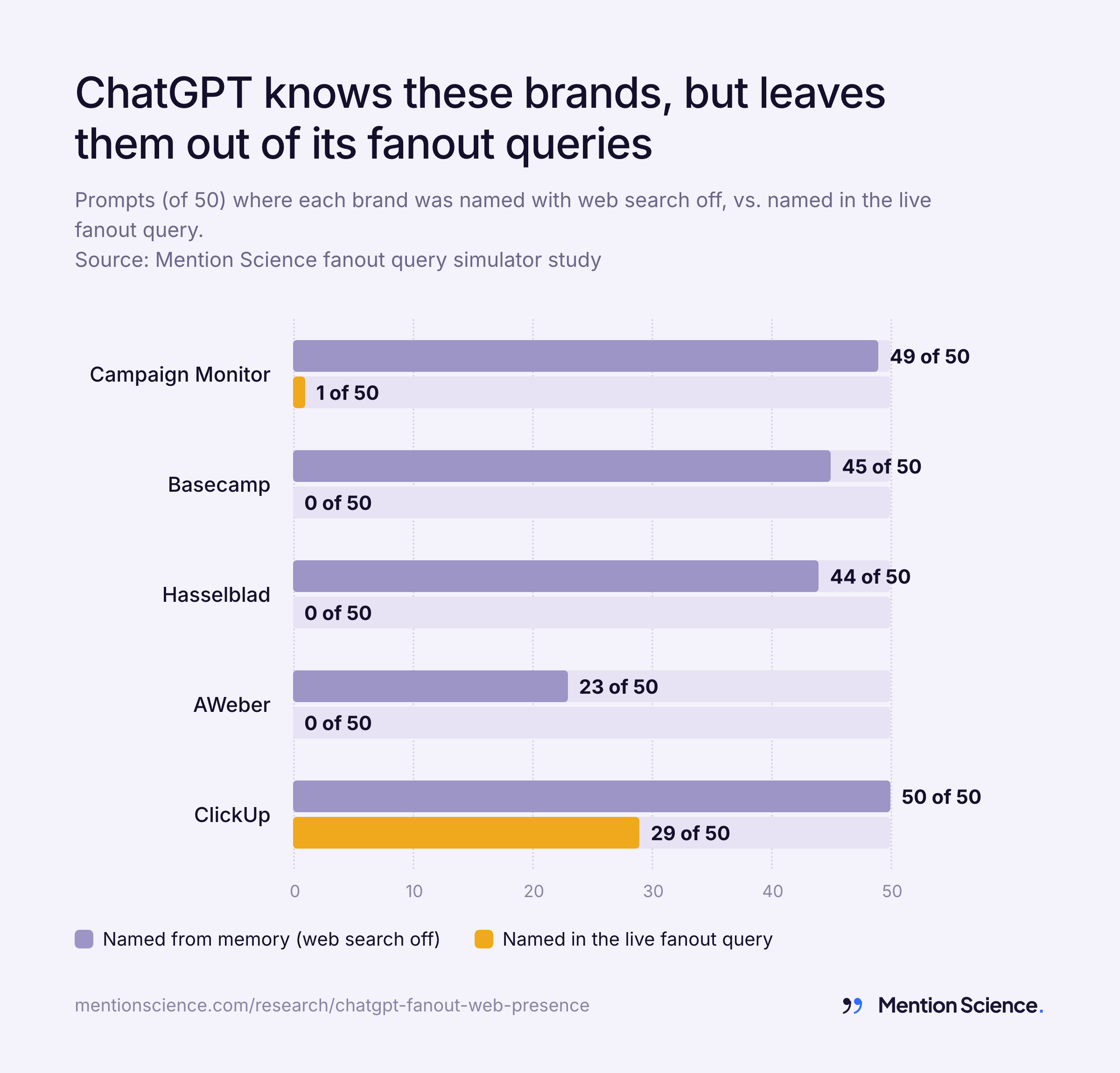
Campaign Monitor came up from memory on 49 of 50 email prompts. It appeared in 1 live fanout query.
Basecamp came up on 45 of 50 project management prompts, and Hasselblad on 44 of 50 camera prompts. Neither appeared in a single live fanout query.
So these brands aren’t unknown, and they aren’t banned. Something else is keeping them out.
Fanout queries only have room for a shortlist of brands
ChatGPT doesn’t let anyone change how many brands go into a fanout query. Our simulator does.
We required the simulated fanout query to name exactly 1, 2, 3, 5, 8 or 12 brands, and recorded the smallest number at which each brand first appeared.
Here’s what that looks like for email marketing tools:
| Brand | In live fanout queries | Enters the simulator at |
|---|---|---|
| Mailchimp | 39 of 50 | 1 brand |
| Constant Contact | 3 of 50 | 2 brands |
| ActiveCampaign | 16 of 50 | 5 brands |
| Brevo | 28 of 50 | 5 brands |
| Klaviyo | 18 of 50 | 8 brands |
| Campaign Monitor | 1 of 50 | 8 brands |
| GetResponse | 0 of 50 | 8 brands |
| AWeber | 0 of 50 | 12 brands |
| MailerLite | 5 of 50 | 12 brands |
| ConvertKit | 1 of 50 | Not in at 12 |
The brands missing from the live fanout queries came back once the simulator had room for them.
AWeber appeared in 2 of 50 simulated queries at a budget of 8, and 47 of 50 at 12. Campaign Monitor jumped from 1 of 50 at 5 to 43 of 50 at 8.
The same thing happened outside email. Basecamp enters at 8, and Hasselblad at 12.
To me, that suggests the live fanout query writer works from a ranked list and cuts it short. Brands below the cutoff are left out—not because they’re unknown, but because they’re further down the list.
Category web presence correlates with which brands make the shortlist
So what decides the order?
We counted how many websites mention each brand near words about its category, using the January 2026 Common Crawl. Then we ranked each brand only against rivals in the same category.
The brands with more category web presence entered the shortlist earlier:
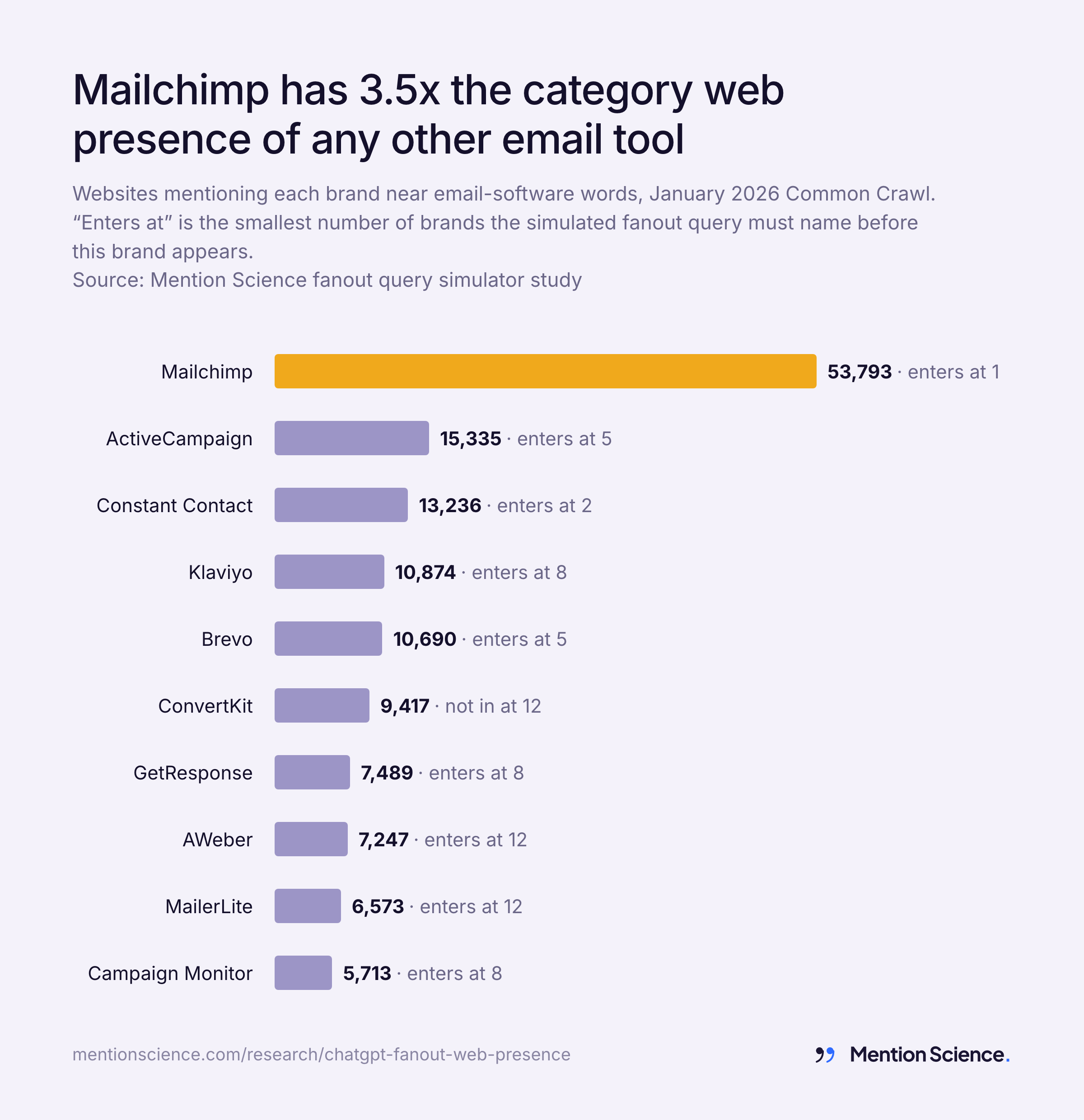
Mailchimp has 53,793 websites mentioning it alongside email software—3.5x more than ActiveCampaign, its nearest rival. It’s also the first email brand in, at a budget of 1.
The same pattern holds in every category we tested. The brand with the most category web presence is the first brand into the simulated fanout query, at a budget of 1:
| Category | Leader by web presence | Websites | Enters the simulator at | In live fanout queries |
|---|---|---|---|---|
| Mailchimp | 53,793 | 1 brand | 39 of 50 | |
| CRM | Salesforce | 29,324 | 1 brand | 35 of 50 |
| Helpdesk | Zendesk | 3,256 | 1 brand | 35 of 49 |
| Password managers | 1Password | 8,483 | 1 brand | 42 of 50 |
| Project management | Asana | 10,437 | 1 brand | 38 of 50 |
| Cameras | Canon | 42,102 | 1 brand | 43 of 50 |
Across all 29 brands, the within-category rankings match at 0.76. For the 25 brands that enter the simulator, it’s 0.85.
And on e-signature tools—a category we fixed in advance as a test—the match was 0.986. DocuSign is first by web presence, and first in the simulated fanout query.
Category mentions matter more than general fame
Count every mention of each brand, and Sony beats Canon.
Count only mentions on camera pages, and Canon beats Sony (42,102 websites vs. 34,849). Canon also enters the simulated fanout query first.
None of this is a big surprise. A brand that the web constantly talks about in a category is the brand a model learns to name for that category.
How to get your brand into ChatGPT’s fanout queries
So, what does all of this data actually mean?
In short, ChatGPT picks a shortlist of brands before it reads a single page, and that shortlist follows category web presence.
1. Check whether you’re in the fanout query
Run the prompts your buyers actually ask, and look at the fanout queries ChatGPT writes—not just the final answer.
If your brand isn’t in the fanout query, the answer starts without you.
2. Earn mentions in your category, not just mentions
Pages that name your brand next to your category’s words are what tracked shortlist position.
Reviews, comparisons, “best of” roundups and directories in your space are where those mentions live. Digital PR that lands you on them is worth more than generic brand coverage.
3. Measure your gap against category rivals
Shortlist position is relative. What matters is how your category web presence compares with the brands you compete with.
Track the gap to the brands just above you, not a raw mention count.
How our data compares to other studies
Suganthan Mohanadasan’s study found that brands named in a live fanout query are cited about 69% of the time, while brands that only show up later, on the pages, are cited about 2% of the time.
Our follow-up study measured the same question at scale:
| Study | Sample | Fanout brands that reach the answer |
|---|---|---|
| Mention Science | 108,396 brands | 71.4% |
| Suganthan Mohanadasan | 119 brands | 68.9% |
Both point the same way. Being written into the fanout query is the strongest position a brand can be in.
This study explains which brands get that position.
Methodology
We ran four steps.
1. Live fanout queries
We extracted 919 live ChatGPT fanout queries from the API, each with the prompt it came from. 782 of them named at least one brand.
2. A fanout query simulator
We built a simulator on GPT-5.6 Luna. It receives the same prompt with web search turned off, plus one fixed instruction: write the web search ChatGPT would write.
Then we compared each simulated fanout query with the live one:
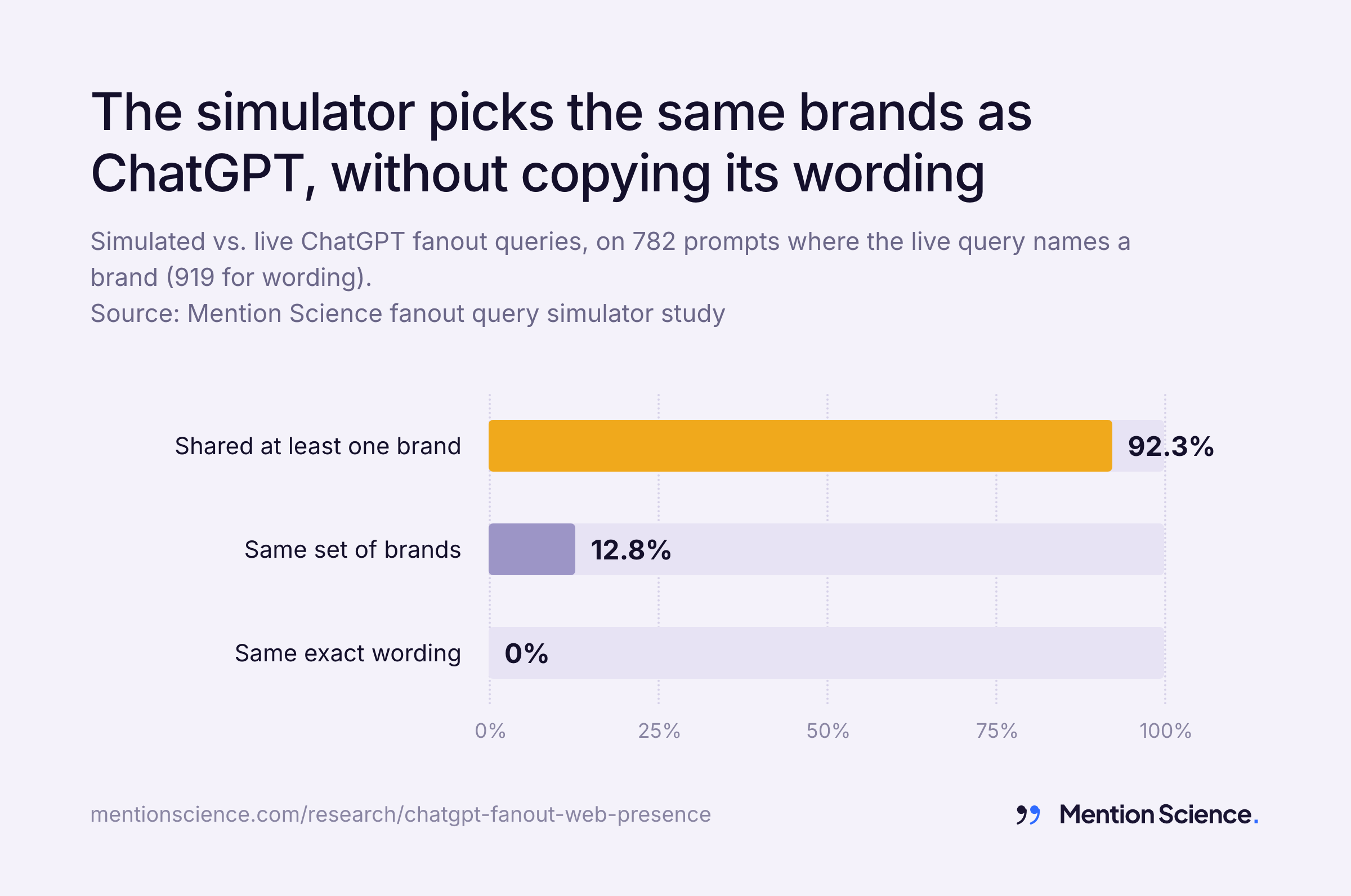
The simulator never copied the live wording, and it rarely produced the exact same set of brands. But it shared at least one brand with the live query on 722 of 782 prompts.
Across a fixed panel of brands, how often each brand appears lines up with the live fanout queries at 0.965.
That agreement is what makes the simulator useful for the question the live system won’t answer.
Compare live and simulated fanout queries on 10 prompts
| Prompt | Live fanout query | Simulated fanout query | Matched |
|---|---|---|---|
| best email marketing software | Mailchimp, Kit, beehiiv, HubSpot | Mailchimp, Brevo, Constant Contact, HubSpot, ActiveCampaign | 2 of 4 |
| best email marketing software 2026 | Mailchimp, Kit, Brevo, HubSpot, ActiveCampaign, Klaviyo | Mailchimp, HubSpot, Brevo, Constant Contact, Klaviyo | 4 of 6 |
| best CRM software | Salesforce, HubSpot, Zoho, Pipedrive | Salesforce, HubSpot, Zoho CRM, Microsoft Dynamics 365, Pipedrive | 4 of 4 |
| best CRM software 2026 | Salesforce, HubSpot, Zoho, Microsoft Dynamics 365, Pipedrive | Salesforce, HubSpot, Zoho CRM, Microsoft Dynamics 365, Pipedrive | 5 of 5 |
| best helpdesk software | Zendesk, Freshdesk, Intercom, Help Scout, Zoho Desk, Gorgias | Zendesk, Freshdesk, Intercom, Help Scout, Gorgias | 5 of 6 |
| best password manager | 1Password, Bitwarden, Proton Pass, Dashlane | 1Password, Bitwarden, Dashlane, NordPass | 3 of 4 |
| best project management software | Asana, Monday, ClickUp, Notion, Jira, Smartsheet | Asana, Trello, monday.com, ClickUp | 3 of 6 |
| best VPN service | None (review sites only) | NordVPN, ExpressVPN, Surfshark, Proton VPN | — |
| best VPN service 2026 | NordVPN, Surfshark, Proton VPN, WireGuard | NordVPN, ExpressVPN, Surfshark, Proton VPN | 3 of 4 |
| best website builder | Wix, Squarespace, Shopify, WordPress.com, Webflow, Framer | Wix, Squarespace, Shopify, Webflow | 4 of 6 |
3. A search-off recall test
Separately, we checked whether the model knows each brand without the web:
- 50 unbranded prompts in each of six categories.
- Web search off.
- One added instruction: “List the current brands that come to mind as leading options. Names only.” We alternated its position before and after the prompt.
- A brand counts when its name or a fixed alias appears anywhere in the answer.
This test doesn’t ask for a fanout query, a ranking or a recommendation. It only measures whether a brand is known for the category.
4. Brand budget and Common Crawl
In the simulator, we required the fanout query to name exactly 1, 2, 3, 5, 8 or 12 brands, and recorded the smallest budget at which each brand appeared.
For web presence, we counted unique websites in the January 2026 Common Crawl where each brand appears near words about its category. We compared rankings only within each category.
Cleaning the crawl didn’t strengthen the match:
| Crawl version | Rank match |
|---|---|
| Raw pages | 0.762 |
| After the quality filter | 0.730 |
| After quality filtering and near-duplicate removal | 0.730 |
Final thoughts
ChatGPT decides which brands to look up before it reads a single page.
That list is short. Well-known brands still get cut, simply because they sit below the cutoff.
And the order isn’t random. It tracks how often the web mentions each brand in its category.
So the work is the same as it’s always been, with a new reason to do it: get your brand named on more pages about your category.
But, bear in mind, this could all shift again with the next model update. If you have questions about this research, feel free to ping us on LinkedIn.
Post by
Antony Deroshan
Antony Deroshan is the co-founder of Mention Science. Antony studies how AI assistants choose which brands to name, and publishes that research here, starting with how ChatGPT writes its fanout queries.